Talkback vs IFB vs PL: broadcast comms terms, decoded
A friendly glossary of the three intercom acronyms you'll hear on every live show, covering what they actually mean, who hears what, and where they overlap.
• John Barker
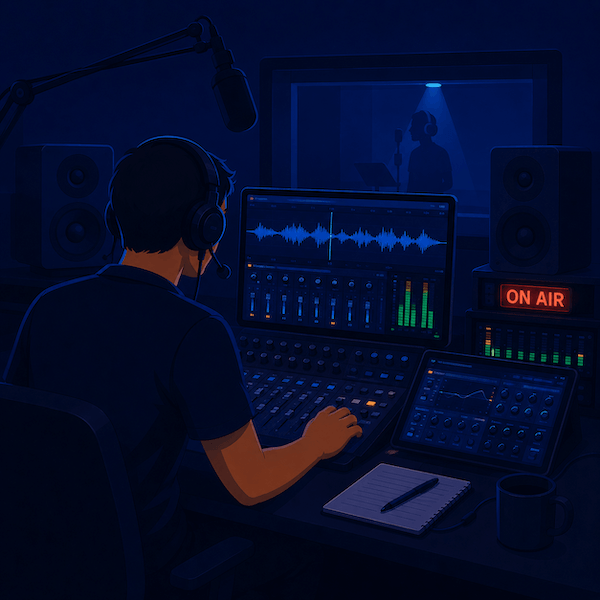
You walk into the control room on day one. Someone hands you a headset and says, “You’re on PL with the crew, and I’ll feed you IFB from the producer when we go live. Talkback is hot if you need it.” You smile, nod, and have absolutely no idea what they just said.
You’re not the only one. The acronyms in broadcast comms have grown up over half a century of analog hardware, and the terms get used loosely even by people who’ve worked in studios for years. Let’s untangle the three you’ll hear most.
PL: the party line
PL stands for “party line.” It’s the always-on, everyone-can-hear-everyone crew channel. Picture a conference call that never hangs up: the director, the technical director, the audio engineer, the camera ops, the graphics op, all on one shared line, talking back and forth as the show runs.
Some things to know about PL:
- It’s bidirectional. Anyone on it can talk; everyone on it hears.
- A show usually has more than one PL. There’s often a “main PL” for the director’s lane and a separate “audio PL” so the A1 and A2 can debug a feedback issue without filling everyone’s ears.
- You can be on multiple PLs at once and decide which to talk on with a button press.
- It’s the closest thing to “the room everyone’s in.”
If you’ve ever been on a guild Discord with a designated voice channel for one team, that’s basically a PL.
IFB: interruptible foldback
IFB stands for interruptible foldback. It’s a one-way feed sent to on-air talent, usually the program audio mixed with a producer’s voice that can cut in over the top.
The “foldback” half is the program feed: what the talent needs to hear to do their job. A news anchor hears the show’s audio in their earpiece. A remote guest hears the host’s question.
The “interruptible” half is what makes it useful: when the producer presses a key, their voice replaces (or ducks) the program feed in that earpiece. “Wrap up, two minutes.” “Camera one, you’re back.” The talent gets the cue without needing to break eye contact, and the audience hears nothing.
A few rules of thumb:
- IFB goes to the talent, not from them. They can’t talk back on their IFB feed.
- One IFB feed per talent, because the cues for the host are usually different from the cues for the field reporter.
- The mix is configurable: some talent want program audio loud and producer cues quiet, others the opposite.
- A two-second delay on an IFB feed is a disaster. Latency matters more here than almost anywhere else in the production.
If you’ve ever heard a news anchor say “my producer is telling me…”, they’re listening to IFB.
Talkback: the asymmetric return
Talkback is where it gets fuzzy. The word is used a few different ways, but the most common in modern usage is:
- An asymmetric return path from talent or a remote contributor back to the producer or director, separate from the main program feed.
- Sometimes used as a synonym for the producer’s mic feed itself (i.e., “the talkback to the host”).
The classic talkback workflow: a guest is in a remote booth doing an interview. The host can hear them on program audio. The producer needs to ask the guest to repeat a name without the host hearing, so they tap a talkback key, the guest gets a brief private message in their earpiece, and the show keeps moving.
Talkback is essentially the inverse of an open PL: targeted, often momentary, and not heard by the rest of the world.
How they relate
Here’s the way these three usually fit together on a show:
| Channel type | Direction | Who’s on it | Open or pressed? |
|---|---|---|---|
| PL | Bidirectional | Crew (director, TD, A1…) | Open, always on |
| IFB | One-way to talent | Talent’s earpiece | Pressed (producer cuts in) |
| Talkback | Targeted return | Producer ↔ specific person | Pressed |
The mental model: PL is the room. IFB is whispering in someone’s ear. Talkback is the private aside.
Where mix-minus and program feed come in
Two more terms worth knowing because they show up in the same conversations:
- Program feed (often “PGM”): the actual broadcast audio mix, or what the audience hears. Talent hear this in their IFB minus their own voice (so they don’t get an echo).
- Mix-minus: the program audio with one person’s voice removed before sending it back to them. Required for any remote guest unless you enjoy howling feedback.
These aren’t intercom channels exactly (they’re audio feeds) but they’re cousins. A well-run show has all of them working together: PL for crew chatter, IFB to cue talent, talkback for private asides, and a clean mix-minus so nobody hears themselves.
How this maps to a software-first system
If you’re coming from physical hardware, software intercom can feel like everything’s been collapsed into one box, because it has. In spacecommz.io, all of these patterns are just configurations of channels, groups, and members:
- A PL is a regular channel where multiple members are assigned both talk and listen.
- An IFB is a talent link, listen-only by default, with the producers added to a group that can talk into it.
- A talkback is a one-on-one channel between two members with talk-and-listen on both sides, usually opened just for a moment.
- PGM mode is the setting that strips out noise reduction and enables stereo when you’re piping in a clean program feed.
You don’t need to memorize the historical names to use a modern system, but the terms will keep showing up in conversations, vendor docs, and crew calls. Now you know what people mean.
Want to keep going?
The fastest way to feel the difference between an open PL and a one-way IFB is to set one up. The talent links doc walks through it in about five minutes. For the wider picture of what a comms system is doing under the hood, What is a production intercom? is the companion piece. And if these acronyms are showing up in a sports broadcast specifically, Sports broadcast comms 101 is where they all live in their natural habitat.