Sports broadcast comms 101: who talks to whom during the game
A friendly walkthrough of how a sports broadcast crew is wired together, covering every position, every channel, and how to scale the model for college, high-school, and esports productions.
• John Barker
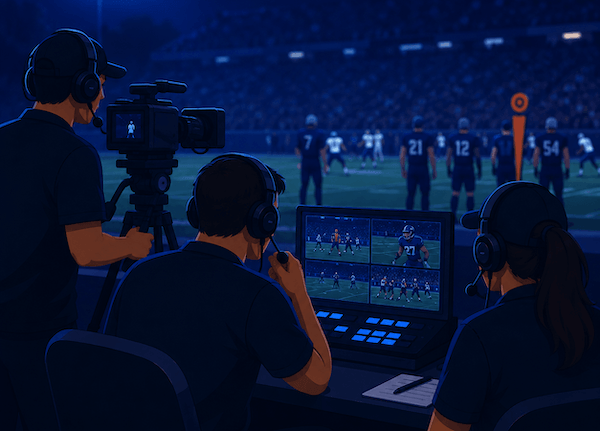
Fourth quarter. Six seconds left. A coach calls a timeout, a kicker jogs onto the field, and somewhere in the back of an OB van a producer says quietly into a headset: “Camera 4, stay wide on the bench. Camera 6, find the kicker. Replay, queue the last drive. Tally, ready.”
In the next forty-five seconds, fifteen people will move in coordinated patterns without anyone in the stadium hearing a word. That’s sports broadcasting at its best, and it’s almost entirely a comms achievement.
If you’ve ever wondered how the choreography actually works, or if you’re producing a college game, an esports tournament, or a high school playoff and trying to figure out how the pros do this, here’s the architecture, role by role.
The positions on a typical broadcast
A mid-sized live sports broadcast crew usually breaks into five clusters, each with its own communication needs:
The control room (or truck) cluster. This is where the show is built.
- Producer: runs the show. Decides what stories to tell, when to go to break, when to roll a feature.
- Director: calls the shots. Lives on the main PL with cameras and the TD.
- Technical Director (TD): physically operates the switcher.
- A1: audio mixer. Handles announcer mics, crowd, music, and the program mix.
- EVS / replay operators: find and queue replays for the director.
- Graphics op: runs lower thirds, scores, stat overlays.
- Tape / record op: manages recording and feeds for highlights.
The on-field cluster. The people physically at the venue.
- Camera ops: usually four to ten of them, covering wide, tight, slash, end zones, handhelds, etc.
- Spotters: call out plays, players, and stat-worthy moments to commentators.
- Sideline reporter: interviews coaches, players, fans.
- Floor manager / stage manager: herds people during commercial breaks.
The talent cluster. The voices the audience hears.
- Play-by-play and color commentators.
- Studio host (if there’s a pre/post show).
The stat cluster. Often forgotten, always essential.
- Statistician: feeds real-time stats to graphics and commentators.
- Researcher: feeds context, anecdotes, and historical stats.
The remote cluster. Increasingly common. See REMI.
- Remote graphics, replay, or director working from another city.
- Remote producer in some pre/post show models.
The channel architecture
Now the question that matters: who hears whom?
A working channel layout for the crew above:
| Channel | Who talks | Who listens | Type |
|---|---|---|---|
PL Director | Director, TD | Cameras, EVS, graphics, floor manager | Open PL |
PL Producer | Producer | Director, A1, EVS, graphics, talent IFB | Open PL |
PL Audio | A1 | A2, audio assistants, recording op | Open PL |
Spotters | Spotters, statistician | Commentators, producer | Open PL |
IFB Play-by-play | Producer (push), program mix | Play-by-play commentator earpiece | One-way IFB |
IFB Color | Producer (push), program mix | Color commentator earpiece | One-way IFB |
IFB Sideline | Producer (push), program mix | Sideline reporter earpiece | One-way IFB |
Talkback Sideline | Sideline reporter, producer | Each other | Targeted talkback |
A few patterns worth noticing:
- The director and producer have separate PLs so the director can call camera shots without the producer’s editorial conversation in everyone’s ears, and the producer can talk to talent without distracting cameras.
- Each on-air voice has their own IFB feed because they need different cues. The play-by-play needs production cues; the sideline needs interview prompts.
- The audio team has its own PL because debugging a mic problem during the game shouldn’t be a public conversation.
- Spotters get their own channel because they need to whisper-coach the commentators without the rest of the crew filtering it.
If you’ve worked in radio you might recognize this as a structured version of the producer-DJ-engineer triangle, just with twelve more axes.
Pre-game rehearsal
The pattern that separates clean shows from chaotic ones is a real soundcheck before the broadcast goes live. Forty-five minutes before kickoff, the producer runs a roll call:
- “Director, hear me?” “Got you, producer.”
- “Camera 1, hear the director?” “Loud and clear.”
- “A1, levels good on play-by-play?” “Levels are good.”
- “Sideline, do you hear me on IFB? Producer hot.” “I hear you.”
- “Talkback test: sideline, can you reach me?” “Reaching you, producer.”
Round-robin every position. Don’t accept thumbs-up; require a verbal confirmation. The live show comms checklist has the longer version of this routine.
Handling commentators and sideline reporters
Talent are the most fragile part of the chain because they have a job to do while you’re talking to them. Two principles:
Talk less, cue more. A producer who narrates every thought into a commentator’s earpiece will lose them by the third quarter. Cues are short. “Wrap.” “Two minutes.” “Stat ready.” “Score change.”
Mix the IFB feed how the talent wants it. Some commentators want the program mix loud and producer cues quiet so they can hear the crowd. Others want the inverse. Set this per person and don’t change it during the show.
For sideline reporters specifically, you’ll want talkback both ways: producer to sideline for cues, sideline to producer for “hey, the coach just said something interesting, can I get a hit?” Without that return path, the sideline reporter is shouting into a void.
Adapting for college, high school, and esports
You don’t need a 30-person crew to use this model. Compress it.
College broadcasts typically have a single director-producer combo, two to four cameras, one A1, one graphics op, one or two commentators, and an optional sideline reporter. Collapse the producer and director PLs into one. Keep separate IFBs per talent.
High school streams might be a director, two camera ops, one announcer, and a graphics op. One PL for the crew, one IFB to the announcer, done. The whole layout fits in a free spacecommz.io space with a single channel and a single talent link.
Esports productions swap “stadium” for “production studio” but use a remarkably similar architecture. The big difference: caster IFB is replaced by in-game audio mixing, and “spotters” are replaced by an observer team feeding the director ideas about which player to follow. The PL/IFB pattern is the same.
Where remote contributors fit
A growing trend in college and regional sports: the director or producer works from a central production hub instead of traveling to every venue. The REMI workflow keeps the comms architecture identical. What changes is where the people are, not who talks to whom.
The way it works in practice: the venue has cameras and a small on-site team. The producer in another city is a member of the same comms space, on the same PLs, just sitting at a different desk. Audio rides over the internet. Latency is in the 100ms range. Once you’ve done it once, it stops feeling exotic.
A starter template
If you’re producing your first sports broadcast next month and the channel layout above is more than you need, here’s the smallest version that still works:
- One channel:
Crewfor director, cameras, graphics, audio. Talk + listen. - One talent link:
Announcer IFB, which the producer can talk into.
Two channels. That’s enough for a high school playoff or a small college regular-season game. As you grow, peel off audio onto its own channel, give the producer their own PL, add IFB feeds per talent. The model scales gracefully.
If you want to see how others have set this up, the sports broadcasting use case walks through real-world layouts at different scales. For the language and acronyms that get used on PL during the game itself, Talkback vs IFB vs PL is the cheat sheet.
The art of the cue
Sports broadcasting comms is a craft as much as a technical system. The architecture above is a starting point, not a recipe. The crews who do this best are the ones whose producer says “two minutes” and ten people move in lockstep, not because they were told what to do, but because they were on the right channel and trusted the cue.
Build that, and the rest of the show falls into place. We’ll see you in the truck.